Originally published prior to 2016
As you drive down from Lodestone Lake, you pass a few things of interest: Nine Mile Berts, who moved here to escape his alcoholic addiction and thought that here he could lead the sober life he desired. Standing tall are the timbers he built, inside the remains of his furniture, a few jars of well-expired preserves (open at your own risk), and the signs of the animals who have frequented it since his passing. Shortly below that you’ll pass the open coal mine that has tried to bring in the possibility of piping out Coal Bed Methane Gas as a power source- yes, clean-burning, but water tainting – a double-edged blade, as per most of society’s needs.
However, just after that, on an offshoot to your right, a small, occasionally used road leads to the start of the forgotten ghost town of Blakeburn. Fierce determination best describes the people who lived in Blakeburn 100 years ago, and the abandoned structures that still stand today at the site of BC’s best-unknown ghost town. Home of the 5th worst mining disaster in the province, and the 45 men who died the day that Portal #4 exploded, August 13, 1930, starting the downward spiral that would spell the end of the close-knit community. Hundreds of off-roaders pass by every year, failing to stop and explore every turn on their descent out of Whipsaw to Coalmont below.
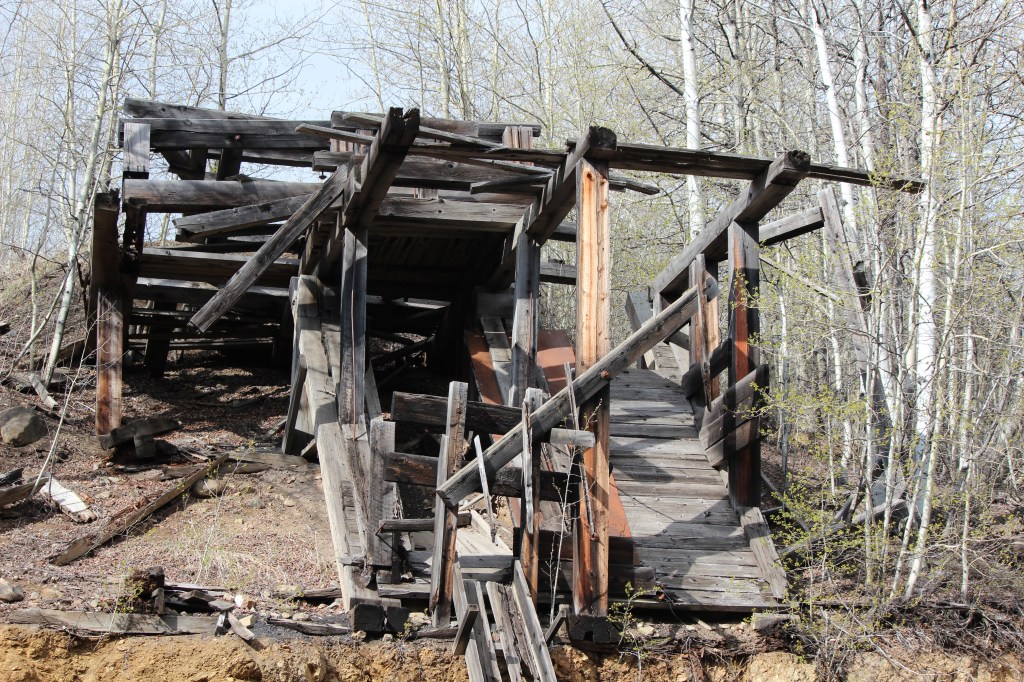
This first offshoot is one of several over the next few km, offering both great photographic opportunities and an environment where you can close your eyes and feel the energy of those who lived here. The voice of Wilf Valentine echoes in the distance as the smell of men’s sweat, mixed with acrid smoke from the explosion, enters your nostrils; you feel the tunnel collapse, and your mind wonders whether it is your imagination or the ghosts that stayed here playing with you.
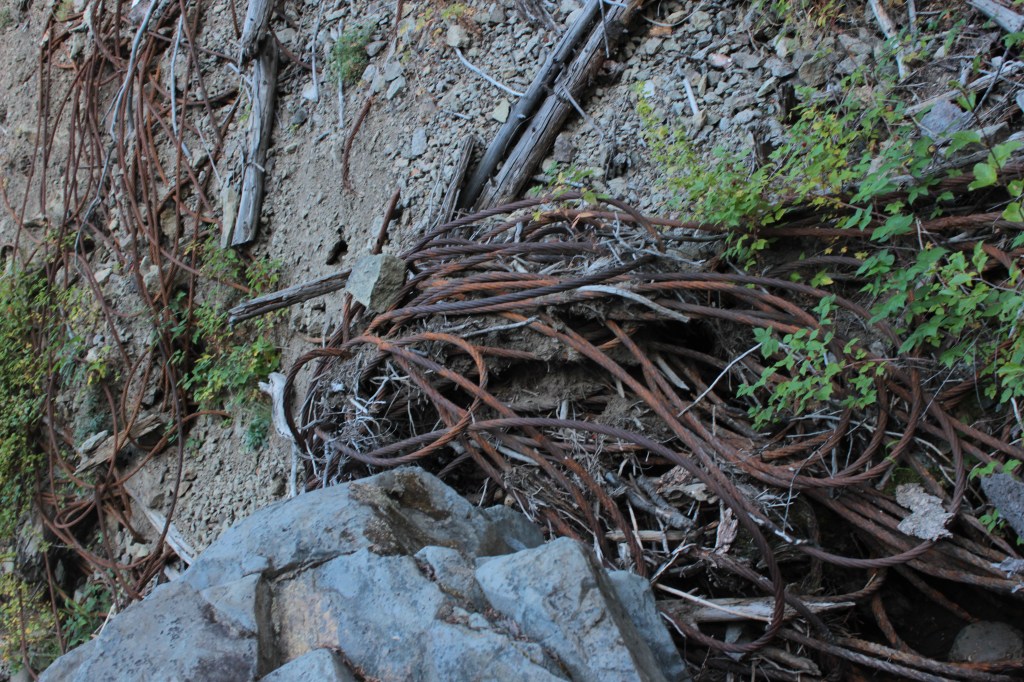
At the bottom of the descent, heading right takes you to Portal #5, where you find the remains of Logan’s home and a few company buildings. Long since collapsed and run down by Mother Nature, the portal is almost unrecognizable. From here, the old Wagon Trail runs along the higher ground, no longer fully travelable by vehicle; the lower ground is home to the railroad bed, which is still hikeable. You can see ties, cables, and spikes, along with the occasional anchor through a tree. A third option, running parallel to the railroad bed, bypassing a downed tree, can be traversed with a stock 4×4.
Running alongside the railroad bed, slightly below, one can see the remains of cables and a few scattered homes and structures. Rounding the final corner, one stumbles upon the remnants of Fred Fielding’s home still standing, the word Saloon painted in black above the front door. The day of the explosion a nearby neighbour, Mrs. Gilmour was sitting on her veranda when noticing a very fine deposit of dust on her arms. She had just taken a couple of steps when the explosion occurred, reverberating throughout her body. Shockingly, neither she nor her family were injured. No one ever fully determined the cause of the explosion in Portal #4.
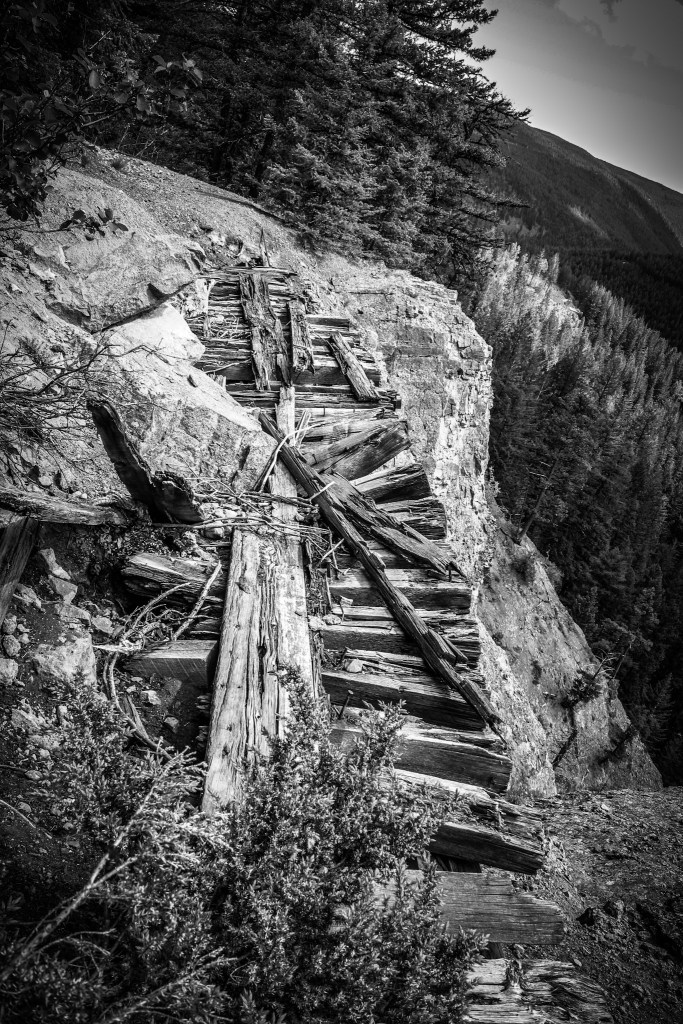
At Fred’s home, park and walk the few hundred meters to Lover’s Leap and the Outhouse collection. You’ll pass several remaining trestles used to transport coal to the trams and workers in Lower Blakeburn; each run consisted of a driver and multiple carts. As unique as these trestles are, they wouldn’t inspire the confidence Lover’s Leap did to build and ride. Standing at the top, you can see its sheer drop-off of hundreds of feet to the canyon below. Rumour has it that several unsuccessful rides were made at this turn, with the driver surviving but the coal carts falling into the gully below, where you can find them if you hike up the creek from the bottom. Today, only Hoary Marmots dare touch the timbers and cable anchors that steady it, barely holding the remaining ties and parts of the mountainside together.
Continuing down the railroad bed, you’ll find one more unique site. As you round the corner, you first see a bed pan hanging in a tree, some odds and ends, and, if you dig around, you can find interesting remains, such as ceramic “Vancouver Beer” bottles imported from England. Before you also lies the site of 4 standing outhouses, no other structures. This creates a quizzical moment, leaving one to wonder why this was needed. No homes here, rail cars not unloading; perhaps they wanted to distance the smell of all those working men from the workplaces. A better question is why, in so many abandoned cabins and locations we visit, outhouses survive while the homes don’t.
In the past, the rail bed continued; however, a landslide has long since taken away any remaining signs of it, and the Wagon Trail above. If you choose to continue, follow the vibrant green flagging tape that should still exist; it will take you to the Mullin Coal Pit, a well-known quad playground.
Heading back up to the main road, your next stop is to your left, off the Blakeburn Sports Field. The open clearing, now home to only a few Aspens, in its earlier life, one would see soccer fields and tennis courts. Down this road you’ll find both structures and the 16 standing towers in the “Tram Line Tour” that descends into Coalmont. Built on a gravity-fed system and constructed with hand-hewn wood by the men in the mines, you can picture the carts riding down full on one side and up empty on the other, with the occasional man hitching a ride.
Shortly up this road, on your right-hand side, you’ll find your first tower, this one fallen. Park near here, and you can venture off to your left and find several remains of homes in an area better known as the Barnes Camp Subdivision. Follow this road; about every 300 meters, you’ll see a new tower. They continue for several kilometres, then reach a fork; take the left route and pass through the cattle gate. Here are two of the more remarkable standing towers, tall and traced with moss.
Continue a short bit (to N 49.30.346 W 120.43.240), and you’ll reach the most mesmerizing of all: Anchor Hill. The carts descended from Blakeburn above to this point; however, they still needed to climb this hill and descend into Coalmont below. This created several challenges for the gravity-fed system; the solution was over 20 towers placed a few meters apart. This allowed a controlled, gradual ascent in both directions and avoided the complications caused by incorrect tautness. Follow the flagging tape up the trail, and a few hundred meters to your right.
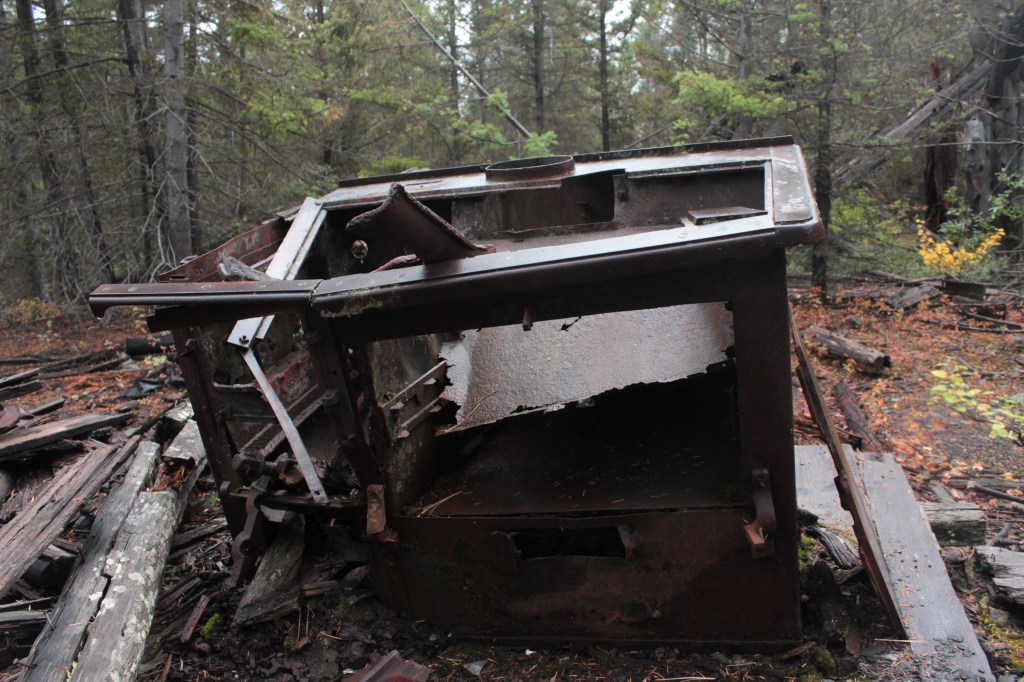
The sight that greets you is mesmerizing: cables anchored through trees; benches that once sat on the ground are now suspended in mid-air as the anchor trees have grown. The foundations of the bunk house used by the men working this section, and the stove that kept them warm on nights when temperatures reached -30. The biggest thrill comes from standing at the top of the hill and seeing tower after tower after tower descending below.
This only touches on a few of the places you can discover here; other offshoots lead you to root cellars, concrete anchors, homes, and so much more. You can spend days among the ghosts of Blakeburn, opening roads to the past, better experienced when you know the stories of those who lived here. You can find many of the histories and coordinates mentioned above through a sport called Geocaching, or by contacting me at kris@4wdabc.ca. I hope that the next time you travel through Whipsaw, you leave a little extra time to discover a new world on your trip out.


