How a whiskey-soaked afternoon in 1898 put a father and his two sons on trial for murder — twice — and produced a case file that even a courthouse fire couldn’t destroy.
Precurser: AI has been used to assist with the transcription of the court case, it has been compared ot the original and is believed to be accurate. It was also used in the compilation of this article. This is an attempt to work with the massive records of DeKalb County, Tennessee and making them accessible. Corrections are welcome.
On a Sunday around noon in the spring of 1898, in a little railroad settlement called Mine Lick in Putnam County, Tennessee, a man named Giles Bradford was shot in the back and left to die beside the road, his clothes catching fire as a woman cradled his head in her lap. Within three years the killing had been tried before two separate juries, survived the burning of the county courthouse, and climbed all the way to the Tennessee Supreme Court in Nashville.
What follows is drawn entirely from the certified transcript of the record and the lawyers’ briefs in State of Tennessee v. James, Clay & Claud Brassell. Where the witnesses flatly contradicted one another — and they did, constantly — this account says so, because the contradiction is the story.
Historical Background
Mine Lick in 1898 was the kind of place the turn-of-the-century Upper Cumberland produced by the dozen: a depot, a general store, and a saloon clustered where the railroad passed through. Cookeville, the county seat, was a wagon ride away, and much of life still ran on horses, road carts, and buggies. Men carried knives as a matter of course; on the day of the killing, the record has them variously armed with pocket knives, a pair of brass “knucks,” and at least one pistol.
Liquor sat at the center of it. Giles Bradford’s brother, John Bradford, ran what the defendants’ brief bluntly calls a “blind-tiger” — period slang for an illegal drinking spot — “selling whiskey in violation of law.” Even John’s own widow, Alcy Bradford, conceded the point from the witness stand with a memorable shrug: “He had Government License. Yes he was selling Liquor in violation of law.” Sunday “treating” — men standing rounds of whiskey for the crowd — was the immediate backdrop to the violence.
Crucially, the Brassells and the Bradfords were not strangers or feuding clans, at least not on the surface. By nearly every account, including the State’s, they were neighbors and friends who had been drinking together that very morning. One defendant, Claud Brassell, had even married into the Bradford connection. The trouble, when it came, came fast and drunk.
Two threads of grievance flicker in the background of the record. The defense claimed — through affidavits from witnesses it could not get to court — that Giles had been threatening the Brassells, supposedly furious that they were “working to catch John Bradford” over a Post Office break-in, and boasting that “the damned Brassells did not fool with him… for if they did he would kill two or three of them.” And the community’s appetite for violence did not end that Sunday: by the time of the second trial, John Bradford himself had been murdered, and two men — Jordan Vaughn and Whit Maxwell — were under indictment for killing him, with the widow Alcy as a witness against them. The Mine Lick of these records is a place where the killing did not stop.
The Story: The Day of the Killing
Piece together the points the witnesses agreed on, and the morning unfolds like this.
Clay and Claud Brassell were in Mine Lick early — around eight o’clock. There is a poignant, easily overlooked detail explaining why: Clay was a jail trusty. He had been let out of the Cookeville jail on a misdemeanor to visit his mother and was due back that Sunday night. He wasn’t going far.
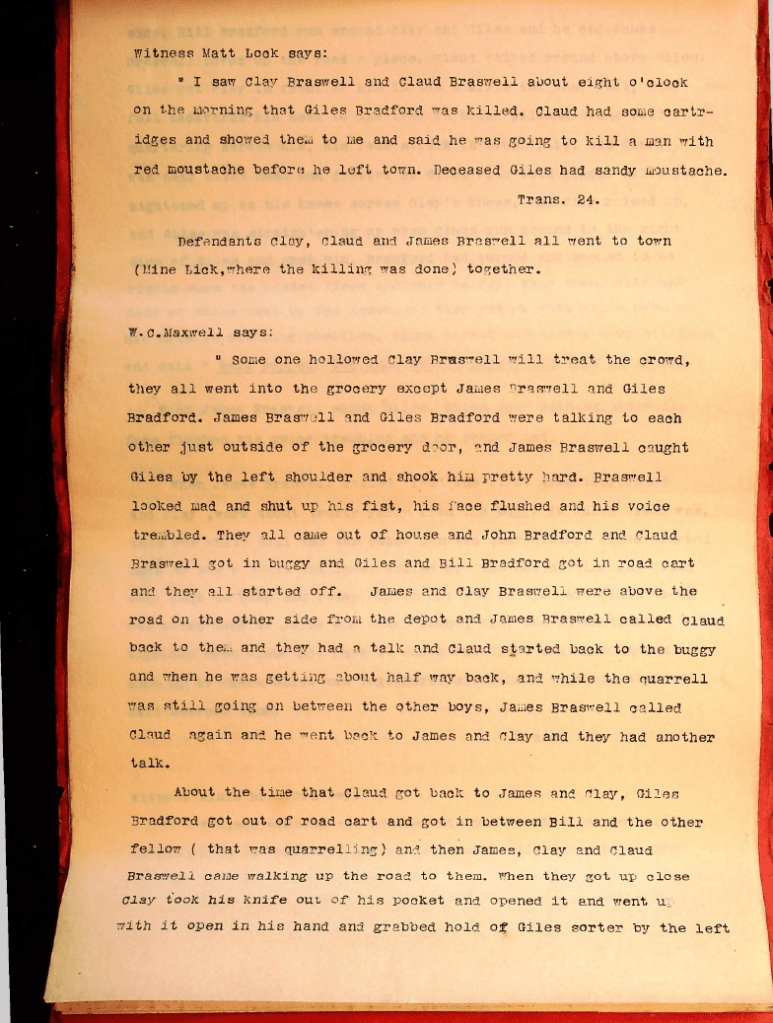
At Sunday school that morning, according to State witness David Patton, Clay made a chilling remark — “Some body will die with his boots on” — though Patton also allowed that Clay “dident appear mad” and that “it has been so long I hardly know how it was.” Another State witness, Mat Lock, swore Claud showed him some cartridges and said he was “going to kill a man with red mustache before he left town.” The deceased, Giles, had a sandy mustache. Claud denied ever saying it, and a defense witness backed him up.
Then came the treating. Someone hollered that “Clay Braswell will treat the crowd,” and the men filed into the saloon and drank — “a number of drinks,” by one participant’s count. When the whiskey ran out, the Bradford party announced they would drive east to Double Springs for more and invited the Brassell brothers along. They loaded up: Giles and Bill Bradford (with Mack Patton) in a road cart; John Bradford and Claud Brassell in a buggy; Lark Bradford going along too. James Brassell, the father, called to his sons, “let’s go home.”
From there the accounts split violently.
Everyone agrees a fight erupted at the road cart — first between the two young Bradfords, Bill and Lark, jerking at each other with buggy whips — and that Clay Brassell, walking home, got pulled into it when Bill Bradford struck him. Everyone agrees Claud got out of the buggy, took hold of his brother, and said some version of “boys, this is no account,” trying to break it up. And everyone agrees that Giles Bradford climbed out of the cart and into the melee, and that Claud Brassell shot him.
What the shot meant is where the State and the defense told opposite stories.
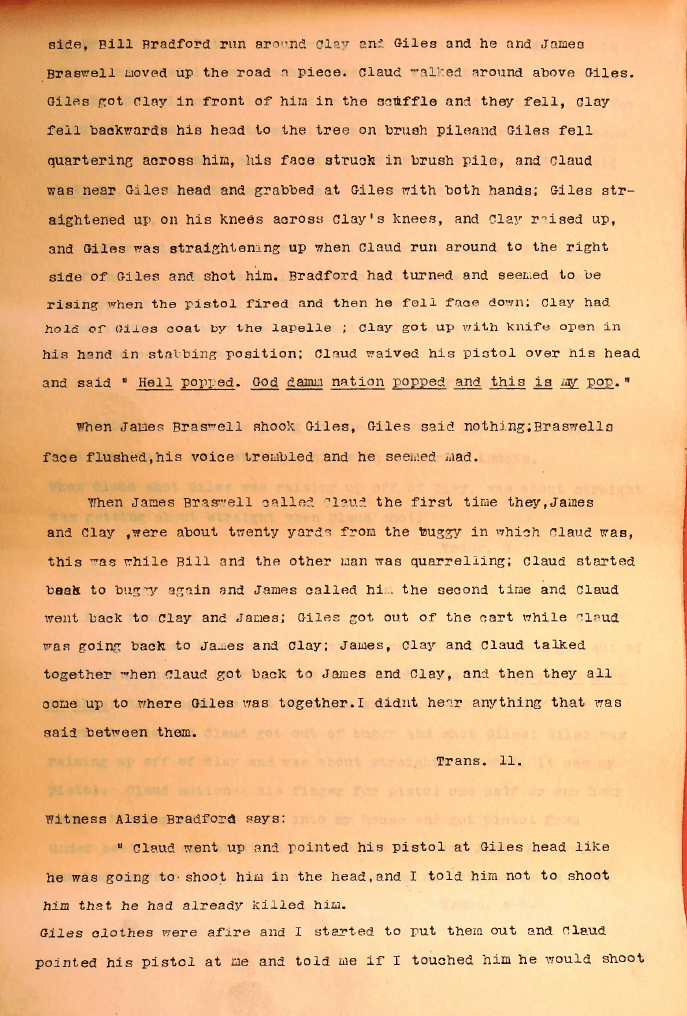
The State’s version, anchored by its key witness W. C. Maxwell (watching from the depot platform) and by Alcy Bradford, was a coordinated attack. The father, James, called Claud back not once but twice; the three Brassells conferred, then came up on the Bradfords together. Clay pulled out and opened his knife, grabbed Giles, and struck him in the breast. In the scuffle they fell — Clay’s head against a tree on a brush pile, Giles across him — and Claud stepped around to Giles’s right side and shot him in the back as he was rising. Then, Maxwell testified, Claud waved the pistol over his head and crowed: “Hell popped. God damn nation popped and this is my pop.”
The defense’s version, told by all three defendants and supported by witnesses like Mac Patton and Dave Brassell, was desperate self-defense. Bill Bradford struck Clay first with the whip; Giles — “a much stronger man than Clay” — knocked Clay down twice onto the brush, got on top of him with an open knife in his hand and a grip on his coat, “making motion with his right hand.” Claud, seeing blood on his brother’s face and a knife at his throat, believed Giles was about to kill Clay and fired to save him. As Claud himself put it: he “only shot to save my brother’s life. I dident think I had time to do any thing else.” There was, the defendants insisted, no plan, no conspiracy — “we had all been friends.”
The Story: After the Shot
However it began, the aftermath is vivid and specific in the record — and it tells us something important: the Brassells did not flee, hide, or vanish.
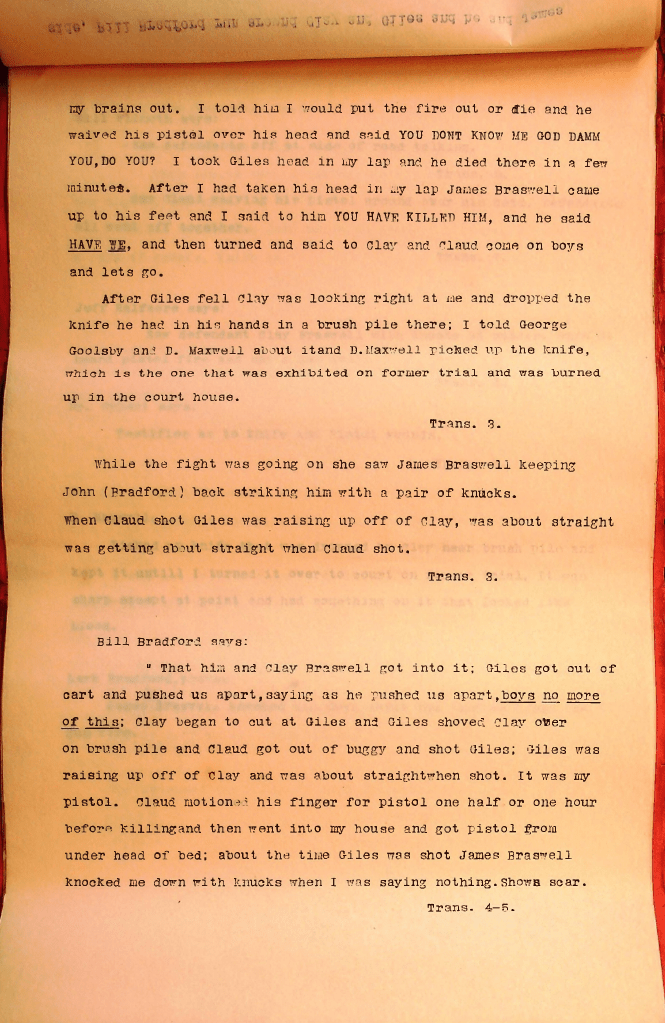
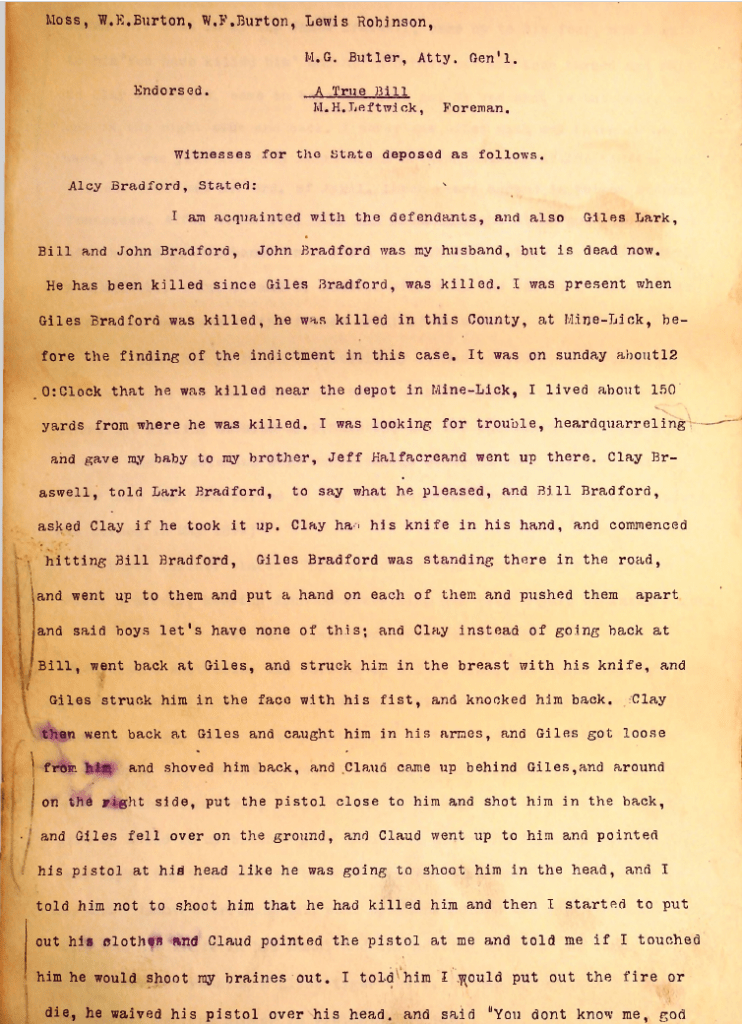
Giles Bradford died within minutes, his head in Alcy Bradford’s lap. In one of the transcript’s most harrowing passages, Alcy described Claud pointing his pistol at Giles’s head as if to shoot again; she told him to stop, that he had already killed him. Then Giles’s clothes caught fire, and as she moved to put out the flames Claud turned the pistol on her, threatening to “shoot my braines out” if she touched him, and snarling, “You dont know me, god damn you do you.” When the father, James, walked up, Alcy said to him, “You have killed him,” and James answered — coldly, if she remembered it right — “have we,” before telling his boys, “come on boys and lets go.”
And go they did — but only home. Mac Patton testified the Brassells “dident stay but little bit after the fight” and “went off towards home.” Bill Bradford, bleeding, walked home; Lark, knocked down by the father, got up and walked home too, met on the road by their own father. This was a killing in front of a crowd, in broad daylight, followed by a walk home — not a getaway.
The law came the same day. Sheriff G. W. Alcorn and his deputy, Bob (R. L.) Jared, arrested the defendants, finding Clay between his father’s place and a neighbor’s. And here Clay made a damning-yet-exculpatory admission: he handed Deputy Jared a small knife with blood on it and said it was the one he had done the cutting with. The defense would build much on that — Clay never denied cutting Giles; he claimed he did it defending himself.
A coroner’s jury held an inquest over the body. When juror George Goolsby searched Giles, he found “less than a dollar” in silver and no knife on him — a detail the defense wielded hard, because it contradicted Maxwell’s claim that Giles had been flashing a wad of bills, and because the widow herself said Giles’s knife had already been picked up off the ground.
Then began the long legal road that makes this case unusual.
The Brassells were indicted in May 1898 for first-degree murder. At their first trial in May 1899, the jury convicted all three of second-degree murder and fixed fifteen years each. They moved for a new trial — and then fate intervened. On May 13, 1899, the Putnam County courthouse burned to the ground, destroying the court records, the minutes, and the indictment itself. The court had to reconstruct (“supply”) the lost entries from the judge’s own memory, a remarkable procedure preserved in the transcript. At the September 1899 term the grand jury returned a fresh indictment, and the first conviction was set aside for a new trial. For two years the defendants remained free on $5,000 bonds each, term after term, as the case was continued again and again — partly because the defense kept trying, unsuccessfully, to obtain the testimony of one Lige Bussell, a supposedly neutral eyewitness who had gone to Texas.
At the second trial in May 1901, a second jury reached the same core verdict: all three guilty of second-degree murder — this time fixing the punishment at ten years each. The court overruled the motion for a new trial, sentenced the three to the penitentiary, disqualified them from holding office, and taxed them with the costs. They appealed.
The Witnesses: Compelling Statements
The case turned less on physical proof than on people, and a handful of statements did the heavy lifting:
- W. C. Maxwell, the State’s central eyewitness, supplied both the “two conferences” theory of conspiracy and the single most quotable line in the record — Claud’s post-shooting boast, “Hell popped. God damn nation popped and this is my pop.” If the jury believed Maxwell, the Brassells acted in concert and Claud reveled in it.
- Alcy Bradford gave the emotional core: the dying man in her lap, the pistol turned on her, and the father’s chilling “have we.” The defense spent enormous energy attacking her — more on that below — precisely because her account was so devastating.
- David Patton and Mat Lock supplied the whiff of premeditation: “Some body will die with his boots on,” and the cartridges and the “man with a red mustache.” Both were sharply disputed.
- Bill Bradford, though a State witness, handed the defense a gift by admitting the pistol Claud used was his own — “It was my pistol” — and that he, Bill, had been the one who “got into it” with Clay first.
- Dr. W. E. Sypert, the physician, gave the cold anatomy of the killing (below), and his finding that Giles was shot in the back cut against any tidy claim of a fair face-to-face fight.
- The defendants themselves testified — permitted under the law, as the judge instructed the jury — with Claud’s plain insistence that he fired only to save his brother.
The Evidence
Forensic testimony. Dr. Sypert examined Giles soon after death and found three wounds: two from a knife (on the right side, one running toward the back, one near the spine running forward) and one from a pistol. The fatal gunshot entered about two inches from the spine on the right side, between the seventh and eighth ribs, ranged downward and diagonally through the body, and lodged just under the skin on the left side between the tenth and eleventh ribs. The ball was a .38 caliber, and it “passed through both lungs.” That, Sypert said, “was the shot that produced death.”
The knife that wasn’t there. The single most contested piece of physical evidence was a knife found open on the ground near the body — buckhorn handle, a hooked “hawk-bill” blade, a hole in the handle for a chain, a chip broken out of one side — with “something on it that looked like blood.” The State argued it was Clay’s knife, dropped after he stabbed Giles (Alcy testified she saw Clay drop a knife in the brush). The defense answered that it was Giles’s own knife: Mat Lock swore he had lent Giles that very knife weeks earlier, and that Giles’s sister, Kansas Elmore, had stepped on his foot and shaken her head to hush him about it; the widow, Bettie Bradford, testified her little boy had Giles’s knife that morning and she’d told him to hand it back to his father. A defense affidavit even claimed the “blood” on the blade was really a tobacco stain. Remarkably, the jury at the second trial could not examine either knife for itself — both the ground knife and the knife taken from Clay had been exhibited at the first trial and then burned in the courthouse fire. Only the memories of witnesses survived.
Character, and the war over Alcy Bradford. A striking share of the trial was consumed not by what happened but by who could be believed. The State attacked the Brassells’ reputations; the defense mounted a full-scale assault on Alcy Bradford’s, calling a parade of witnesses to brand her “a little lewd” and therefore unworthy of belief. The defense also stressed that her attackers’ credibility was itself compromised, and that her chief tormentors were kin and allies of Jordan Vaughn and Whit Maxwell — the very men she was helping to prosecute for her husband John’s murder. The State, in turn, rehabilitated both Alcy and W. C. Maxwell with witnesses vouching for their good character.
Affidavits and absent witnesses. Because the defense could not produce several key figures — the Texas-bound Lige Bussell above all — much of its case for a new trial rode on sworn affidavits: from F. P. Elmore (the tobacco-stain claim), John Kiger, William Thomas, and N. M. Cox, who happened to be both a defense lawyer and James Brassell’s brother-in-law.
The Legal Question
This was not a constitutional case. It was a hard question of ordinary criminal law, and it had two halves.
First, and most important: how can three men be guilty of murder when only one pulled the trigger? No one disputed that Claud — and only Claud — fired the fatal shot. The State’s answer was the law of conspiracy and aiding-and-abetting: if the three Brassells had a common design to attack the Bradfords, or if James and Clay were present, “ready and willing” to help, then all three were guilty of the killing carried out by one. As the trial judge charged the jury, if the defendants “entered into a conspiracy… all being present ready and willing to carry out this unlawful purpose,” and Claud fired “in execution of this common design,” then “all would be guilty… although they may not have originally contemplated taking life.” The defense’s answer was that there was no agreement at all — the Brassells were friends of the Bradfords caught in a sudden drunken brawl, and Claud acted alone on impulse.
Second: was the killing justified? For Claud, this was the classic question of self-defense and defense of another. Tennessee law, as the judge explained, gave a brother “the same right to fight in the defense of his… brother, as such… brother has to fight in his own defense” — but not if that brother was himself the aggressor, “in the wrong in bringing on the fight.” So Claud’s guilt turned on two sub-questions: Was Clay the one who started it? And did Claud reasonably believe Clay was in danger of death or great bodily harm when he fired?
On appeal, the defendants layered on the usual claims: that the evidence didn’t support the verdict, that the trial court wrongly refused a continuance to get the absent Bussell, that newly discovered evidence warranted yet another trial, and that the jury charge was — in the words scrawled in the margin of the handwritten brief — “confusing & erroneous.” The State’s brief called that same charge “faultlessly accurate.”
The Ruling — and the Cliffhanger Ending
Here is where honest legal history has to draw a line.
At the trial level, the outcome is unambiguous and was reached twice. Two separate Putnam County juries — the first in May 1899, the second in May 1901, under Judge W. T. Smith — each found all three Brassells guilty of second-degree murder. (A criminal conviction in Tennessee required a unanimous verdict of all twelve jurors, and both juries returned one.) The second jury fixed the sentence at ten years each in the penitentiary; the trial court overruled the defendants’ motions for a new trial and in arrest of judgment, entered judgment, and granted the appeal on $5,000 bonds. The State’s brief leaned hard on that doubling: two juries, hearing the witnesses in person, had convicted.
The core legal reasoning available in this record is therefore the trial court’s — most fully expressed in Judge Smith’s charge to the jury, which laid out the law of malice, murder, and manslaughter; the rules of self-defense and defense of a brother; and the doctrine of conspiracy and aiders-and-abettors described above. The judge was careful to give the defense its due, instructing that if there was no conspiracy and Claud shot “without Clays knowledge, consent or procurement,” then Clay “would not be guilty,” and neither would the father unless his presence “was for the purpose of aiding” the killing. The jury simply did not believe the lone-impulse story.
But the question a reader naturally wants answered — what did the Tennessee Supreme Court finally decide? — cannot be answered from these papers, and it would be a disservice to pretend otherwise. This document is the case file on its way up to the Supreme Court: the trial record and the competing briefs, certified by the Circuit Court clerk on November 15, 1901, and stamped “Filed” in the Supreme Court at Nashville on November 23, 1901. It contains no appellate opinion, no vote of the justices, and no final disposition, because those came after this record closes. The Brassells’ story, as preserved here, ends not with a verdict but with a question mark — three men out on bond, their fate handed to the highest court in the state, the last page of the file the clerk’s signature under the embossed seal of Putnam County.
A note on sources
Every fact, quotation, date, and figure above is taken from the 99-page certified transcript and the appellants’ and State’s briefs in State of Tennessee v. James, Clay & Claud Brassell (Circuit Court of Putnam County; killing at Mine Lick, April 3, 1898; second-degree-murder convictions in 1899 and 1901). Quotations preserve the original 1901 spelling. Where witnesses disagreed, both versions are given and attributed; nothing has been invented to fill the gaps. The one thing this record does not contain is the Tennessee Supreme Court’s ultimate ruling — which, if it survives, would have to be traced through the Court’s own reports, not this case file.


