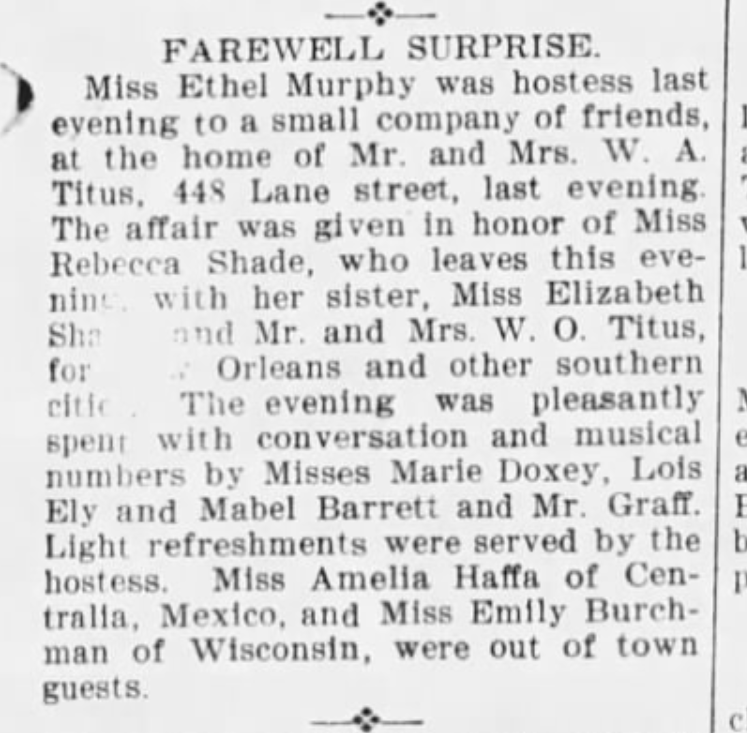
The year was 1912, and my great aunt Rebecca Shade was 22 years old; a few months earlier, her friends had held a farewell surprise party for her and her sister McClada, as they would soon be off to New Orleans.
She was engaged to Fred Morris, and they were to be married the next Ides of May. Her life was a happy one by most accounts, even employed as a bookkeeper in a bookstore. She had her human moments and was subject to the mishaps we all have, such as burning her knee as she carried hot water up the stairs.

Unfortunately, she would soon be granted the fearful news that she was with child. She was horrified at the humiliation that being an unwed woman with child would bring upon herself and her family.
In October of 1912, she would meet with Dr. Anna Longshore-Jackson to terminate her delicate condition. Later Fred Morris would claim that Rebecca had visited other doctors, some of which had given her medication to produce a miscarriage, but they had failed.
She told her work and family she was going away for a few days and had arranged to stay at an apartment near Dr. Longshore-Jackson.
After her arrest, the prosecutor claimed that Dr. Longshore-Jackson confirmed to certain persons that she had performed many abortions and miscarriages, charging $25 for single women and $15 for married.
The procedure was completed; however, after the operation, Rebecca became ill and was rushed to the Presbyterian hospital. A 2nd surgery was needed; however, it failed, and her young life would be cut short immediately upon the operating table.
Her autopsy indicated that Rebecca’s womb was punctured or wounded, likely brought about by the use of an instrument. However, it is possible that Rebecca’s prior attempts to terminate the pregnancy contributed to her death. Dr. Nesbit confirmed that it was of his opinion that Rebecca’s death was caused by blood poisoning produced by the use of an unsterilized instrument.
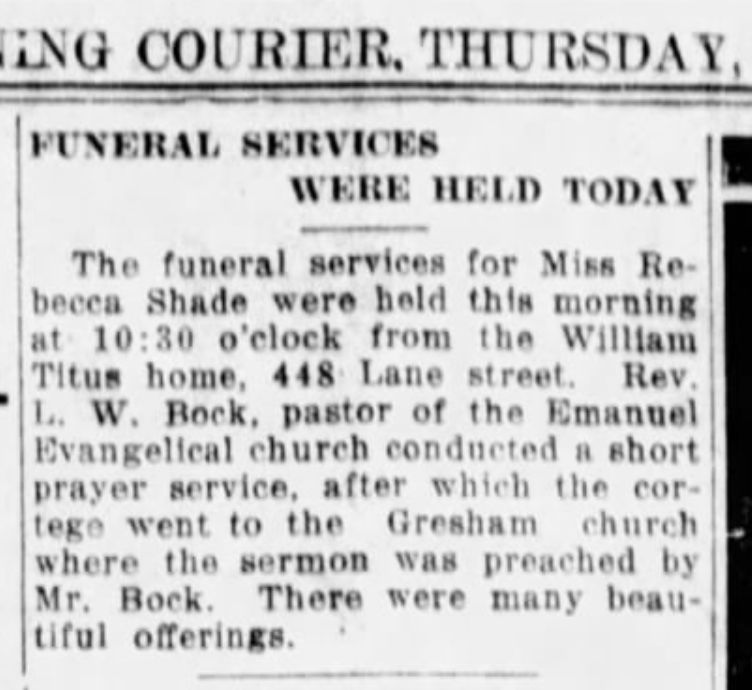
As a result of her death, Dr. Anna Jackson Longshore-Moon was charged with 2nd-degree murder charges. She was held on a $3,000 bail, and she denied being involved in bringing about abortion, but Fred and Rebecca applied to her to perform the procedure.
When the Jury was selected, they were asked, “Do you approve of a physician’s performing a miscarriage upon a woman in a delicate condition, if, in the opinion of the physician, such an operation were necessary to save a life?”
The attorneys painted Rebecca’s Fiancé Fred Morris as a “double-dyed villain who had robbed a young, trusting girl of her innocence, a priceless heritage.” It was said that Mr. Morris used “all his powers of persuasion to dissuade the girl from any intention in that direction.” And it believed that he had gone “doctor to doctor to get the operation performed.”
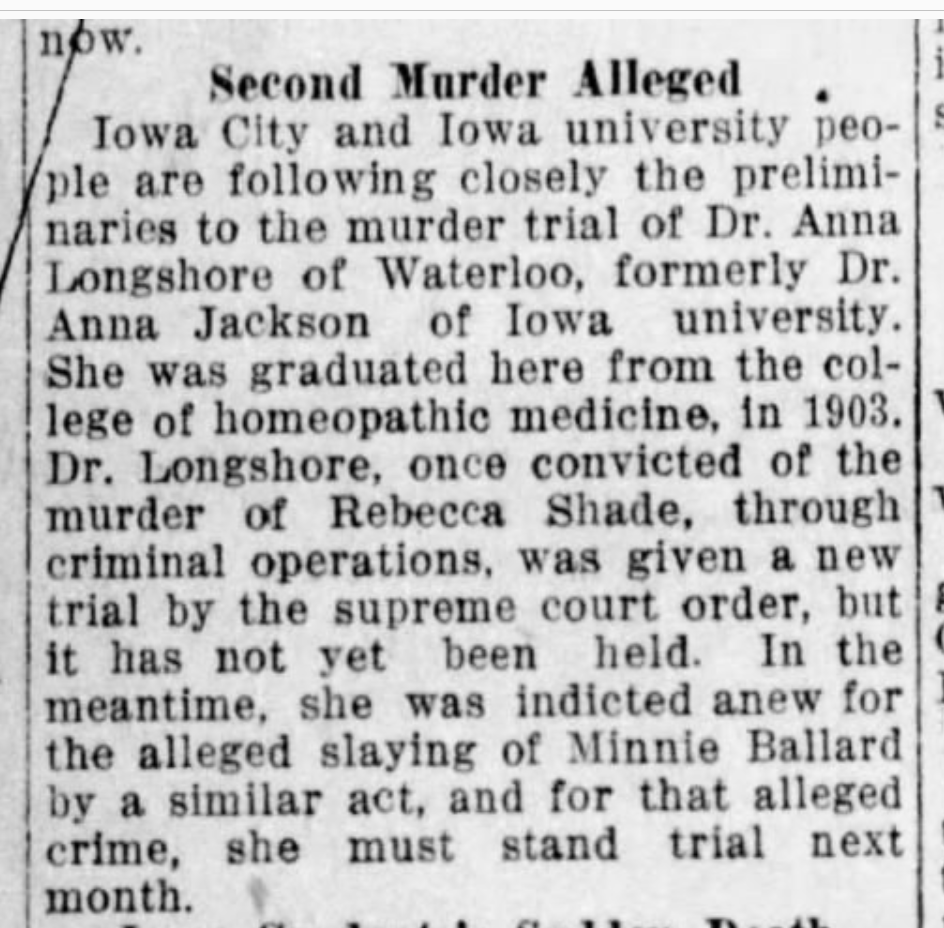
Dr. Jackson was tried and convicted of second-degree murder; she appealed to the supreme court. However, in the meantime, she was charged with the death of a 2nd girl, 14-year-old Minnie Ballard.
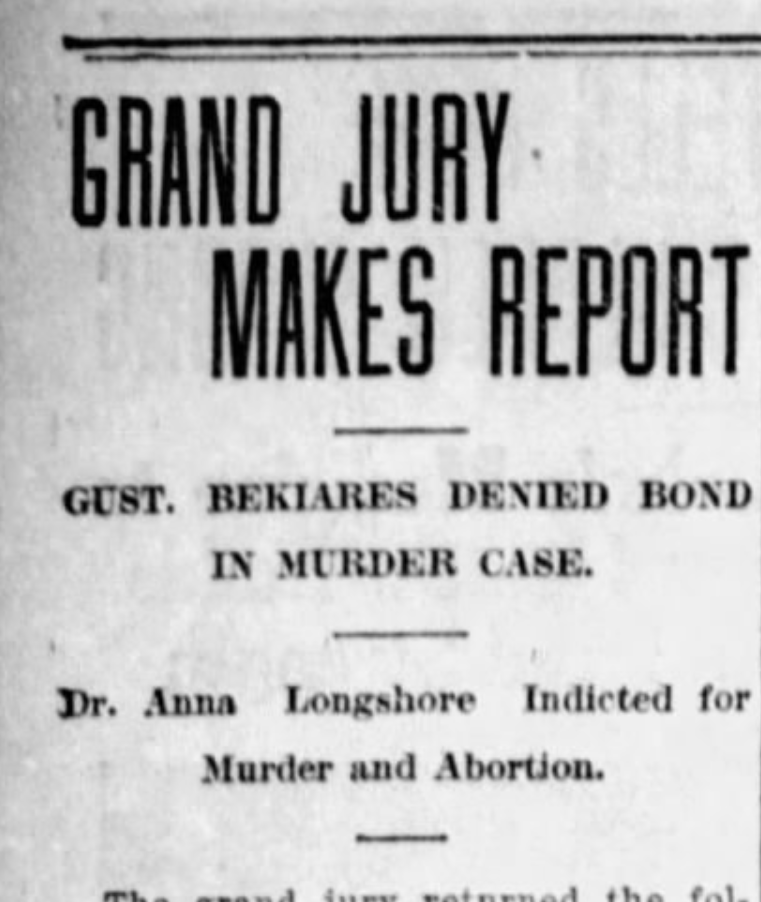
In October of 1914, her appeal based on alleged errors during the trial would be granted. It was found that Fred Morris had supplied the evidence to a considerable extent as a witness for the prosecution.
During the original trial, the prosecution repeatedly stated that women were “victims of her criminal operations.” They also used statements such as “other abortions committed by the defendant” questions; as a result, even though suppressed by the judge, it was viewed that they intensified the damage imputation of the prosecutor.
The judge also found fault that the state’s primary theory was that a conspiracy was entered into between the defendant, Fred Morris, and Rebecca. As a result of these concerns, the judge granted Dr. Longshore-Jackson an appeal.
To perform a procedure for the purpose of having a miscarriage produced has been a debate at the heart of North American for over a century now. With 2001 looking as if more restrictions will be enacted in the U.S. than any previous year, with 90 being passed by July 1st of 2021. Some of these bans range from 6 weeks (often before a woman realizes she is pregnant) to 20 weeks, a diagnosis of Down syndrome or cases of fetal abnormality and others. Even measures to remove the ability of a woman to access the Plan B pill are under consideration.
Those who make the laws, those who stand outside clinics, and those who sit in judgment sit from a high perch of perfectionism. I think it might be safe to say that, for the most part, their bad choices in life, their sex outside of marriage, their nights that they drank too much, did not result in permanent consequences to scar them for life regardless of their choices.
Regardless of where you stand on this matter on the right to choose vs right to life, women have been faced with an unwanted pregnancy for centuries. No woman decides to terminate a pregnancy quickly, and each woman faces a unique set of circumstances if they reach this point in their life.
These women have a common fear, a fear of making the wrong choice. Many face this fear alone, even those with a partner. By the end of this journey, regardless of whether they choose to have the child or not, they will likely no longer be with that partner. If a woman decides to terminate a pregnancy, much like an unwed mother who puts a child up for adoption, it is a secret she will likely carry on her own until her death bed, wondering what if. Fearing the judgement of others should they know, mixed with a sense of regret and remorse that few can ever grasp unless they have walked that road.
Even though we are 110 years later, society has not grown much. But one thing is clear: restricting abortion and making it illegal, and turning away from Roe vs. Wade will only result in more stories such as Rebecca’s.
In the U.S. between 2011-2013, it was found that 43% of teen females and 57% of teen males had not received any information about birth control before their first sexual encounter. We as a society need to fully embrace proper education and free birth control.
Perhaps if we made sex education a priority, fewer women would be faced with this choice; these laws disproportionately affect women of colour and low-income women. Maybe if we as a society made helping women in this situation with a quality of life beyond food stamps and welfare cheques, fewer would be faced with the heartbreaking choice if they want the child but don’t understand how it can work when it means a choice of feeding the child or themselves. And while we are in that dream world, perhaps society could change. Instead of shaming or whispering about the girl who finds herself an unwed mother, embrace her as a regular part of society and help her succeed as a first prevention step.
But even with that, women will always be faced with this issue, and we as a society need to move legally and ethically forward as opposed to rewinding backwards to before 1972 when girls like my great aunt Rebecca died.
*https://www.newspapers.com/clip/16766608/the-courier/?xid=637 The Courier Waterloo, Iowa February 21st, 1911, Tue • Page 3
*https://www.newspapers.com/clip/16766642/the-courier/?xid=637 The Courier Waterloo, Iowa August 19th, 1911, Sat • Page 12
*https://www.newspapers.com/clip/16767777/the-courier/?xid=637 The Courier Waterloo, Iowa January 22nd, 1913, Wed • Page 6
*https://www.newspapers.com/clip/16766099/the-courier/?xid=637 The Courier Waterloo, Iowa October 29th 1912, Tue • Page 1
*https://www.newspapers.com/clip/16766400/the-courier/?xid=637 The Courier Waterloo, Iowa November 26th 1912, Tue • Page 6
*148 N.W. 1001 (Iowa 1914), 29446, State v. Moon supreme court.pdf
* https://www.npr.org/2021/07/09/1014475875/abortion-rights-laws-states-record-conservatives
*https://www.plannedparenthood.org/learn/for-educators/whats-state-sex-education-us

 Trix's Trax
Dr. Longshore was charged a 3rd time for performing an “illegal operation” and for second-degree murder. This took place in 1935 when she performed the operation on my 15-year-old 1st cousin, once removed, who perished from sepsis and hemorrhaging following the procedure. Her boyfriend committed suicide the following day. Whenever I am confronted by people who want to make abortion illegal I think of my cousin and her tragic story. (Clayton County Register, Elkader, Iowa – June 20, 1935)
LikeLike